Standard Reader
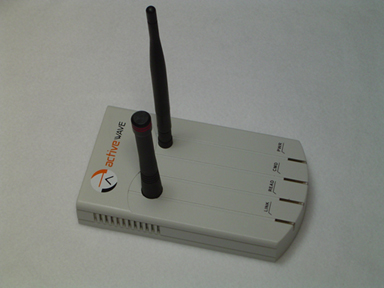
The Standard Reader connected a host computer to the radio side of the ActiveWave system. It received the data every tag transmitted, decoded it and passed it to the host as it arrived.
The host software decided what to do with that data. It could control access to restricted areas, track assets through a building or update stock counts in a warehouse.
The reader sent to tags on one frequency and listened on another, so it could send and receive at the same time. Every packet carried parity bits and a cyclic redundancy check.
Two contact inputs let it sense a door or an exit button. Two relay outputs let it drive door strikes, magnetic locks, cameras, lights and sirens.
Set up as a field generator, it could call tags on a schedule or when a motion sensor tripped. It reached the host through a serial port, Ethernet or, as an option, a wireless network.
Specifications
The datasheets are historical documents. Their phone numbers, addresses and e-mail are no longer ActiveWave's.
Functionality Reads and writes RFID tags Multi-Tag Read Capability Yes Transmit Frequency to Tag 433 MHz Receive Frequency from Tag 916 MHz, 927 MHz, or 868 MHz Range 30m (100 feet) to tag
85m (280 feet) from tagHost Communications RS232 9600 - 115200 Baud
Ethernet 10/100 Mbps
WLAN (optional) 2.4 GHz, 5.2 GHzPower 12Vdc, 1.5A Dimensions without antennas 150 mm x 85 mm x 27 mm (5.9 in x 3.3 in x 1.1 in)
with antennas 150 mm x 85 mm x 167 mm (5.9 in x 3.3 in x 6.6 in)Weight 680 grams (1.5 lbs) Case Material Impact resistant polystyrene with UL94-HB flammability rating Temperature Operating -35C to +50C (-31F to +122F)
Storage -40C to +85C (-40F to +185F)Indicators RF LED On while receiving packet from tag.
HOST LED On while sending validated tag packet to Host.
ACCESS LED On while transmitting packet to tag.
POWER LED On when Reader is powered.Connectors Power 12Vdc, 1.5A
Ethernet RJ-45 female to Host
Motion Detector RJ-11 male
Host Comm. Same RJ-11 male to Host (DB9 female to Host optional)
Input Two contact sense inputs
Output Two isolated dry contact relay outputs
These figures are the original units' claims, quoted as their source printed them. Where two ActiveWave datasheets disagree, this site quotes each and does not reconcile them. A rating or a test result belongs to the original units and does not carry over to a rebuild.
Nothing on this site says a rebuild may transmit on these frequencies as they are. Radio rules differ by country, and the TigeRFID project checks them before it chooses a rebuild's radios.
The datasheet
Standard Reader datasheet (version 10) (PDF). This page's description comes from its first page, and the figures above from its second.
Older datasheets, kept as history:
- Small Reader datasheet (version 9) (PDF). The Small Reader was a smaller Standard Reader without the input contacts and output relays.
Files in the TigeRFID repository
- The readers' schematics and board files (the readers' family folder)
- The readers' bills of materials (the readers' family folder)
- The Small Reader's schematics and board files
These links open the repository as it stood at its activewave-2018 tag. Nobody has rebuilt the original hardware recently, so these files may not make a working unit as they stand.